
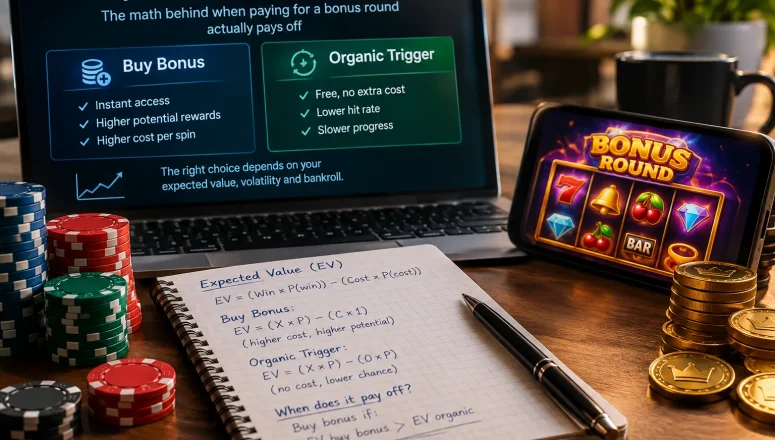
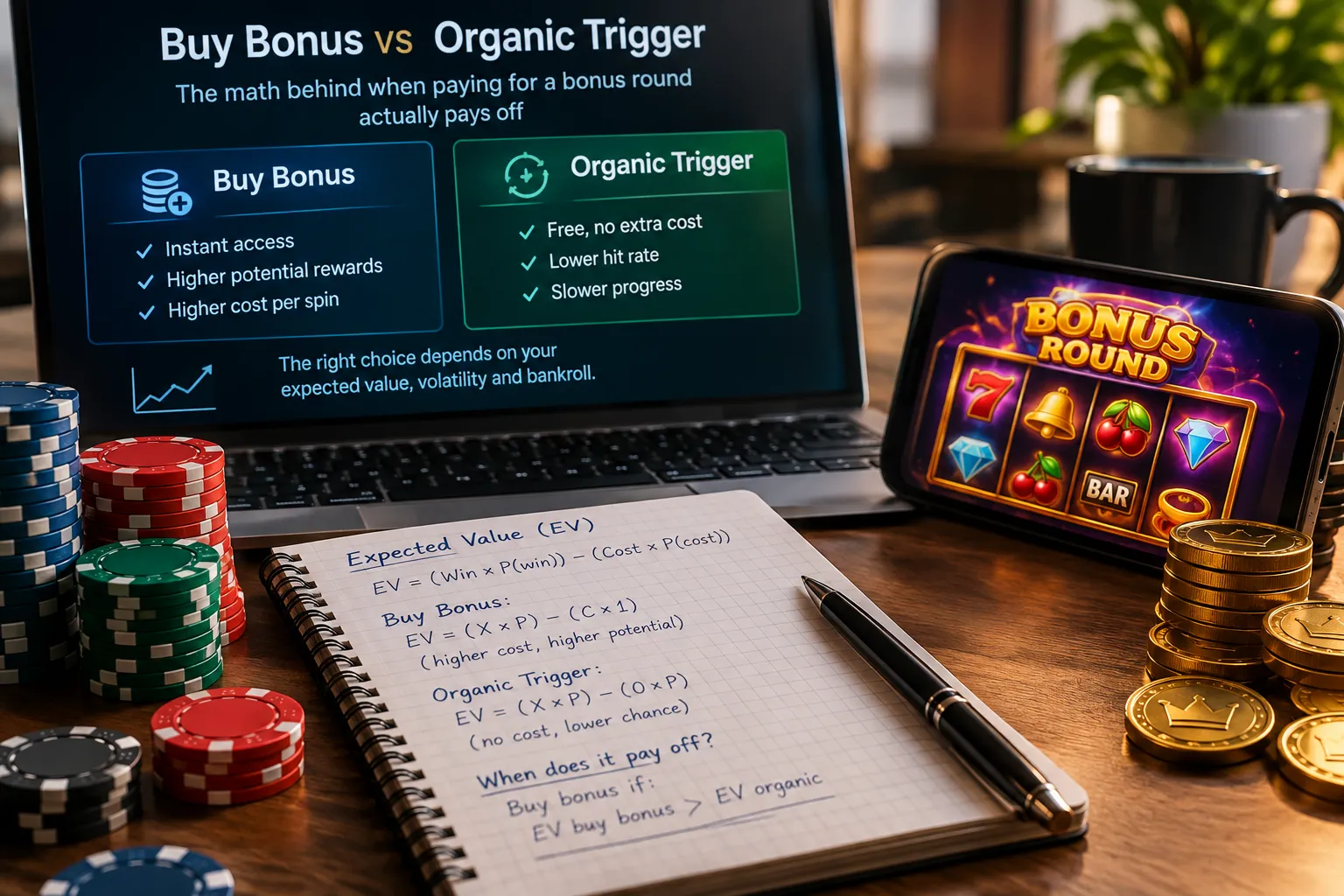
Every modern slot lobby has that button. “Buy feature — 100x your stake.” One click, and instead of waiting through hundreds of spins for three scatters to land, you jump straight into the bonus round. It is tempting, it is popular, and it is also the single most misunderstood mechanic in contemporary slot design. Some players treat the buy button as a shortcut to profit; others dismiss it as a casino trap. The truth sits between, and it is genuinely mathematical: whether buying a bonus “pays off” depends on the game’s RTP, the bonus frequency, the feature buy price, and — above all — what you actually want from the money you spend.
What the bonus buy option really is
A feature buy (also marketed as bonus buy, buy-in, or express bonus) lets a player pay a fixed multiple of the base stake to trigger the bonus round immediately. Pay 100 times the bet and the game forces a scatter combination that would otherwise occur by chance. The mechanic appeared in the late 2010s and spread explosively across high-volatility slots, where natural bonus triggers became so rare that waiting for them could take hundreds of dry spins.
Regulation has since reshaped the picture. Several major jurisdictions, including the UK, have banned direct feature buys entirely, while others allow them with restrictions. Where they remain legal, the buy button is a fixture of the high-volatility segment — and understanding its mathematics is now part of basic slot literacy.
The core equation: price versus fair value
Here is the part most players never see. On a properly designed slot, the published RTP already includes the feature buy option. This has a surprising consequence: if the game’s overall RTP is 96%, and the buy price is set so that the bonus round contributes exactly its “fair share” of that RTP, then buying the bonus at its listed price returns the same theoretical percentage as spinning organically. The developer has done the accounting for you.
But not every developer does it cleanly. Two distortions are common, and both change the decision:
- The buy price can exceed fair value. A bonus that would return 96% of its price in the long run gets sold at an implied cost of 97% or 98% RTP on the buy itself — a quiet tax on impatience, sometimes several percent worse than the base game.
- The buy price can actually be generous. Some studios price the feature at or slightly above fair value to advertise the option as player-friendly, meaning the buy is mathematically neutral to slightly favorable relative to base-game spinning.
The practical takeaway: two slots can both show 96% RTP, and one can still be objectively worse to buy on than the other. Checking the game’s help file — which, in compliant markets, must disclose the RTP of the buy option separately — is the only reliable way to see which side of that line a particular game falls on.
Frequency, price and the hidden variance premium
The second layer of the math concerns trigger frequency. Suppose a bonus occurs naturally once every 250 spins on average, and the buy price is 100x the stake. A naive reading says buying is cheaper than waiting — 250 spins at 1x stake each cost 250, versus 100 for the direct purchase. But this reading ignores what happens during those 250 organic spins: they are not empty. The base game itself returns money in small wins, contributing its own share of the RTP.
A rough way to model the comparison runs as follows. If the base game alone returns, say, 30% of staked money before the bonus, then 250 organic spins cost a net 175 units and deliver one bonus. The buy costs 100 units and delivers one bonus immediately. On those bare numbers, buying looks dramatically cheaper — and in many genuinely high-frequency-bonus games, it is. The reversal happens when the trigger is rarer or the base game pays more: if a bonus arrives once per 500 spins and the base game returns 40%, organic play nets 300 units per bonus versus the same 100-unit buy — and the buy becomes the bargain again. The point is not a fixed rule but a moving balance between base-game return rate, trigger frequency and buy price.
One more factor sits in the background: variance. Buying concentrates the entire session’s risk into fewer, larger events. Ten bought bonuses at 100x each is a 1,000-unit exposure resolved in ten bonus rounds; the same exposure spread over organic play resolves gradually and can be interrupted by cashouts at any point. The expected loss is similar; the shape of the journey is not.
Two strategies, one comparison
The clearest way to see the practical difference is to place the two approaches side by side on the criteria that actually affect a session:
| Criterion | Buying the bonus | Waiting organically |
|---|---|---|
| Cost per bonus | Fixed, stated price (often 60–500x stake) | Variable — depends on trigger frequency |
| RTP exposure | Same or occasionally slightly lower | Same, spread across base and bonus |
| Session length per bankroll | Short, event-dense | Long, gradual |
| Variance profile | Extremely concentrated | Diluted over many spins |
| Control over pace | Total — as many bonuses as budget allows | None — randomness sets the schedule |
| Emotional experience | High peaks, hard troughs | Smoother, but with long dry stretches |
| Best suited for | Short sessions, feature testing, demo of max potential | Regular play, bankroll preservation, patience-driven styles |
Read vertically, the comparison explains the split in player behavior. Neither column is “correct” — they optimize for different things. The buy trades time for intensity; the organic route trades intensity for endurance.
When buying genuinely makes sense
There are situations where pressing the button is not just acceptable but logically justified. They share a common feature: the player’s goal is not grinding RTP but reaching a specific game state quickly. The main cases look like this:
- Testing a game’s maximum potential. If you want to know whether a slot can produce the five-figure win its marketing implies, organic play may take thousands of spins to show you; bought bonuses compress that demonstration into minutes.
- Short time budgets. A 20-minute session with 20 organic spins produces almost certainly zero bonuses on a high-volatility game. The same budget spent on one bought bonus guarantees the experience the game is actually designed around.
- Transparent pricing on the buy itself. Where the game discloses that the feature buy RTP matches or exceeds the base-game RTP, buying is a mathematically neutral way to reshape your session — no worse than spinning, merely faster.
- Studying mechanics before real play. One bought bonus in demo mode can reveal more about a game’s hold-and-win or multiplier system than an hour of reading reviews.
Conversely, the case against buying is just as clear when any of the following is true: the buy price implies a visibly lower RTP than the base game, the budget is small relative to the buy cost (a single failed bonus at 200x can erase an evening), or the player’s tolerance for swings is low. Concentrated variance is not a flaw — but it is a contract, and signing it without reading the terms is where complaints come from.
How to check a game’s buy math before playing
None of this requires advanced tools — the information is usually one menu away. Before committing money to any buy-feature slot, check these five things:
- The published RTP with the buy active, which compliant games must disclose separately from the base RTP.
- The buy price multiplier, and whether multiple tiers exist (some games sell the standard bonus and an enhanced version at different costs).
- The natural trigger frequency, if stated — often found in reviews or the game’s information panel as “1 in X spins.”
- The max win cap, since a 20,000x ceiling means the bonus has genuine upside, while a 2,000x ceiling limits what any bought bonus can ever return.
- Whether the game offers a bonus ante bet — a small stake increase that raises trigger frequency — as a middle path between the two strategies.
That last item deserves a note of its own. The ante bet, typically costing 20–25% extra per spin for a doubled trigger chance, is mathematically distinct from the buy: it keeps variance distributed while speeding up the schedule. For many players it is the honest compromise between the two extremes the buy button forces.
The honest answer to the question in the title
Does paying for a bonus round actually pay off? In expected-value terms, on a fairly priced game, it is a wash: the same RTP, just rearranged into a faster, rougher session. In practical terms, it pays off exactly when time is the resource you are short of and variance is the resource you can afford — when you want the game’s full personality in twenty minutes rather than its averages over twenty hours.
The players who regret feature buys are almost never the ones who understood this trade. They are the ones who bought hoping the math had a loophole — that paying to skip the boring part would somehow also skip the house edge. It does not; the edge rides along in every bought bonus exactly as it does in every organic spin. But for players who know precisely what they are purchasing — an accelerated, concentrated version of the same game — the buy button is not a trap at all. It is a pricing choice, and like all pricing choices, it rewards the people who read the label.