
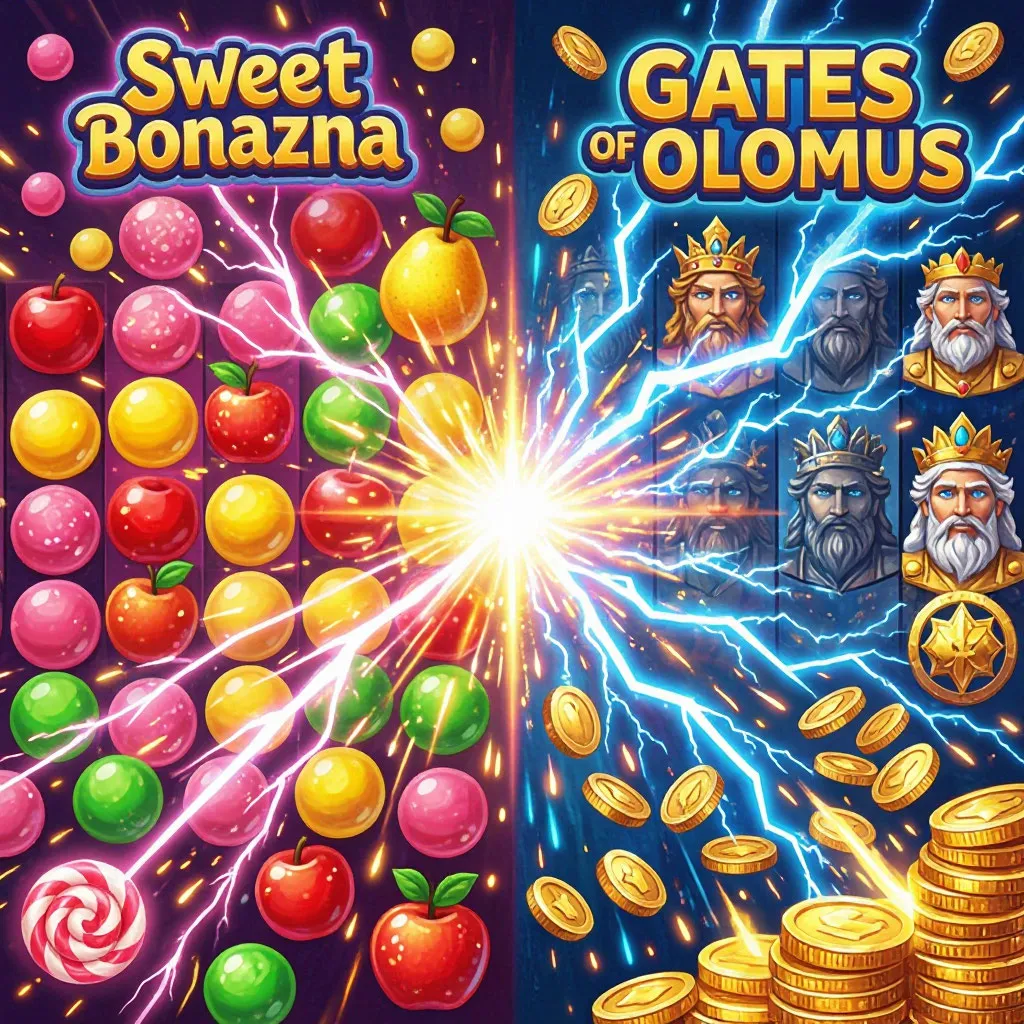
There is a moment every slot player recognizes: the balance is set, the session is planned, and the lobby offers two games that look like siblings. Both come from the same studio, both use the same six-reel cluster engine, both dangle maximum wins in the thousands of times your stake — and yet the sessions they produce could not feel more different. Sweet Bonanza coaxes you along with tumbling candies and waits for the free spins to detonate; Gates of Olympus hands Zeus the multiplier keys and lets him strike on any spin, at any time, without warning.
Choosing between them is not really a question of which game is better. On paper they are nearly twins: comparable return rates, identical grid sizes, the same scatter-driven bonus round. The differences live in the distribution — how often the games pay, how the multipliers behave, and how long your bankroll survives between highlights. This comparison puts every relevant number side by side, walks through each game’s character, and finishes with a straightforward answer on where different budgets belong.
What the two games share before they diverge
The shared skeleton is worth stating once, clearly, because it explains why the debate even exists. Both slots use a pay-anywhere cluster system rather than paylines: symbols pay when eight or more of the same kind land anywhere on the six-by-five grid. Winning symbols then tumble away and replacements drop in, allowing chains of wins within a single paid spin. Both trigger their free spins round with four or more scatter symbols, both offer a bonus buy feature at roughly one hundred times the stake, and both carry theoretical return rates hovering around the industry-standard mark of 96.5%.
That level of similarity is exactly why the decision comes down to the details — the places where the two games quietly part ways. The complete side-by-side comparison looks like this:
| Feature | Sweet Bonanza | Gates of Olympus |
|---|---|---|
| Theoretical RTP | 96.48–96.51% | 96.50% |
| Volatility | High | Very high |
| Grid | 6×5 | 6×5 |
| Maximum win | 21,175x | 5,000x |
| Win mechanic | 8+ symbols anywhere | 8+ symbols anywhere |
| Multipliers | Free spins only (2x–100x) | Any spin (2x–500x orbs) |
| Bonus buy cost | ~100x stake | ~100x stake |
| Free spins count | 10 | 15 |
Two numbers in this comparison do most of the explaining. The maximum win favors Sweet Bonanza dramatically — a ceiling above twenty-one thousand times the stake, earned through stacking multipliers across a full free spins round. The volatility column, however, leans the other way: Gates of Olympus sits in the very high tier, meaning its winning spins are more scarce and its sequences of empty rounds more punishing. The games swap favors depending on which number you weight more heavily, and that is the entire decision in miniature.
Sweet Bonanza: the patient builder
Sweet Bonanza concentrates everything in its free spins round. During the base game, payouts are modest and sessions can drift through long stretches of small returns and near-misses. But once the bonus triggers — typically once in every two hundred to two hundred fifty spins — the rules change completely. Ten free spins begin, and random multiplier candies ranging from 2x up to 100x land on the grid, collecting into a running total that multiplies every win in the round. The famous wins of this game are almost always constructed here: a chain of tumbles feeding into a heavy multiplier, compounding into payouts that can exceed the game’s already enormous ceiling.
The character of the game follows from that structure. It rewards preparation — bankroll deep enough to reach the bonus at natural frequency, patience to sit through the quiet stretches — and it punishes impatience more gently than its sibling does, because the base game at least produces regular small wins. The features most worth knowing before committing a budget:
- Ante bet option — paying 25% more per spin increases the scatter frequency and roughly doubles the natural bonus trigger rate; it is a genuine cost-efficiency lever, not a gimmick;
- Multiplier stacking — several multipliers landing across the same tumble sequence add together before applying, so the difference between a 30x and a 300x bonus round is a matter of accumulation, not luck alone;
- Retrigger potential — three scatters during free spins add five more rounds, extending the bonus and giving the multipliers more room to stack;
- A forgiving base game rhythm — regular small wins keep sessions alive longer per unit of budget than Gates of Olympus typically manages.
That last point matters more than it sounds. For a fixed budget, Sweet Bonanza usually buys more playing time, more bonus-round approaches and more near-misses per session — which is either exactly what you want from a slot, or precisely what you do not, depending on whether you play for duration or for spikes.
Gates of Olympus: the sudden strike
Gates of Olympus refuses to wait for a bonus round to deliver its excitement. On any paid spin, Zeus may throw multiplier orbs — from 2x to 500x — that add together and apply to whatever the spin pays. A cluster of modest wins hit by a pair of 100x orbs becomes a significant payout in an instant, in the base game, with no bonus ticket required. This mechanic is the game’s signature and the reason it became a phenomenon: every spin carries a full ticket to a highlight, and no waiting period softens the tension.
The trade-off is written into the volatility rating. With maximum win capped at 5,000x — generous, but a fraction of its sibling’s ceiling — and with wins compressed into rarer, sharper events, the game produces longer sequences of nothing and demands more bankroll per unit of playing time. Its fifteen free spins, triggered by four scatters, carry the same 100x-approachable multipliers as the base game, making the bonus a supercharged version of an experience you can taste anywhere. The practical traits that define it:
- Base game drama — multipliers can transform any spin, which keeps every round alive in a way Sweet Bonanza’s quiet base game does not;
- Sharper variance — sessions swing harder in both directions; the wins are bigger moments and the dry stretches are longer ones;
- Lower win ceiling — the 5,000x cap means the biggest stories are less extreme, though more frequently approached;
- Constant engagement — the orb mechanic makes this the better watch-and-react game, and by extension the better fit for shorter sessions.
Taken together, these traits sketch a clear profile: Gates of Olympus is a sprint, Sweet Bonanza is a marathon. Neither changes the underlying return — both charge roughly the same long-term price — but they spend that price on completely different experiences.
Budget math: what each game does to your bankroll
The practical question — which slot deserves the budget — resolves into session mathematics. With comparable RTP, the long-run cost per wager is nearly identical, but the shape of that cost differs enormously. A budget that survives two hours on Sweet Bonanza at a given stake level may barely cover forty minutes of Gates of Olympus at the same level, because the very high volatility concentrates losses into longer unbroken stretches. Conversely, when the big round arrives, Sweet Bonanza’s multiplier-stacking ceiling offers a higher peak — the rare session that changes everything is more extreme on the candy side of the fence.
The rational approach is to treat the choice as a portfolio decision rather than a loyalty test. The budget can split across both games according to the session you want: the patient share on Sweet Bonanza, where duration is the product; the aggressive share on Gates of Olympus, where every spin is a potential event. What does not work is playing both at stakes sized for neither — the most common budget mistake in this pairing is underfunding a very high volatility game and running out before its mathematics ever gets a chance to appear.
A simple allocation framework keeps the decision honest:
- Set the session budget before the lobby opens — the number defines which of the two games can actually deliver its intended experience;
- Match stake to volatility, not to RTP — Gates of Olympus wants smaller stakes sustained longer; Sweet Bonanza tolerates larger stakes with its steadier base game;
- Use the ante bet deliberately, not habitually — it is a tool for players chasing the bonus on a schedule, and a tax for everyone else;
- Reserve bonus buys for funded sessions only — one hundred times the stake is a full session’s cost in a single click, and casual use of the feature is the fastest known route to an empty balance;
- Log which game actually suits your temperament — two weeks of small notes on session length, mood and results will answer the comparison question better than any external ranking.
The fifth point is the honest endgame of every slot comparison: the data that matters is the data you generate yourself. Preference between these two games is genuinely personal — it depends on whether your enjoyment lives in waiting or in striking — and no paytable can measure that.
Two games, one honest answer
The direct answer to the title’s question is this: neither slot deserves your entire budget, and the better allocation depends on what you want the session to produce. If you play for duration — longer sessions, steadier rhythms, and the patient pursuit of a stacked free spins round — Sweet Bonanza converts a fixed budget into more playing time and holds the higher ceiling for the rare legendary session. If you play for immediacy — the chance that any single spin turns into a moment, in shorter and sharper sessions — Gates of Olympus is built precisely for that, at the cost of longer dry stretches and a lower peak.
Both games are priced honestly by their maker: the same theoretical return, delivered through opposite distributions. That symmetry is the useful takeaway. When two slots cost the same over time, the only rational criteria left are the ones the mathematics cannot measure — the shape of the session, the rhythm of the wins, the temperament of the player behind the screen. Choose the game that matches the evening you actually intend to have, fund it at a stake level its volatility can sustain, and treat the comparison not as a permanent allegiance but as a rotation: the marathon when you have time, the sprint when you want the strike. The budget, spent that way, buys exactly what it was meant to buy — and that, in slot terms, is as good as money gets.