
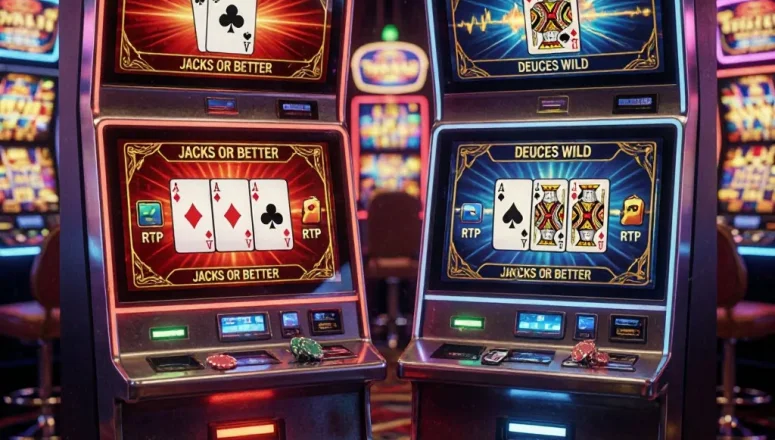

Two video poker machines can sit side by side in a lobby, look almost identical from a distance, and be separated by a chasm of mathematics. One pays you 99.54% of everything you wager back over time — the closest thing to an even fight that any casino game offers. The other pays 100.76% with perfect play, meaning the house actually loses money to a fully skilled player. Those two machines are Jacks or Better and Deuces Wild, and understanding what separates them is the single most valuable piece of knowledge in the entire video poker genre.
The comparison matters because the two games reward completely different habits. Jacks or Better is the discipline of knowing when to hold a mediocre hand: it teaches patience, hand-reading and the subtle art of breaking pairs for draws. Deuces Wild turns the deck inside out — twos become wild cards, every hand ranking shifts, and the whole decision tree changes from top to bottom. Players who learn both learn more about probability than most casino players ever touch, and this guide walks through each game’s structure, paytable, return and the strategic core that makes perfect play possible in both.
Why video poker stands alone among casino games
Before the two variants face off, it is worth pausing on why video poker deserves special attention in the first place. Every other game on the casino floor — slots, roulette, baccarat — is a game of pure chance where the player makes no decisions after the bet. Video poker is the exception: the deal is random, but the draw is a decision, and that decision carries measurable weight. Playing a hand badly costs real percentage points of return, and playing it perfectly captures nearly all of the return the paytable offers.
The mathematical foundation is transparent. A standard video poker machine deals from a 52-card deck, each card appearing exactly once per hand, and the outcomes of the initial deal follow calculable combinatorics. When a player holds and discards optimally, the expected value of every possible hold can be computed precisely — and it has been, exhaustively, for decades. The result is a game where skill genuinely exists, where the ceiling is defined by the paytable, and where the gap between a casual player and an optimal player is often four to eight percentage points of long-term return. No other casino category offers a similar gap between knowing and not knowing.
Jacks or Better: the paytable that defined the genre
Jacks or Better is the baseline of video poker, and its full-pay version — commonly known as 9/6 Jacks or Better for its 9-credit payout on the full house and 6 on the flush — remains the reference point for the entire industry. The rules are simple: five cards are dealt, the player chooses which to hold, and the final hand pays if it contains at least a pair of jacks or better. Nothing wild, nothing exotic — just clean five-card draw poker measured against a fixed paytable.
The return of full-pay Jacks or Better, at 99.54% with optimal play, is achieved only when every decision follows the correct hierarchy of holds. The structure of that hierarchy is what separates casual players from perfect ones, and the most important rules of the optimal strategy are these:
- Never break a made paying hand — a pair of jacks or better already pays; the only exceptions are the rare four-card straight flush draws that outrank it in expected value;
- Hold four to a royal flush over almost everything — even over a made flush, the royal draw is worth more in expected value when the payout justifies it;
- Low pairs beat four-card flush draws in tight decisions — the standard hierarchy favors the low pair over a four-flush in most paytable versions, a rule that trips up many beginners;
- Discard everything when holding garbage — with no high cards, no pairs and no draws, holding one card to “keep something alive” costs measurable return on every hand;
- The flush pays 6, the straight pays 4 — knowing the exact paytable in front of you is the precondition of every strategy rule, because altered payouts change the optimal holds.
The last point deserves emphasis: optimal strategy is paytable-specific. A machine paying 8/5 instead of 9/6 changes several decisions in the hierarchy, and playing 9/6 strategy on an 8/5 machine surrenders a measurable slice of return. The first habit of the video poker player is reading the paytable on the glass before sitting down — it is the single cheapest inspection in all of gambling, and it decides more than any in-game decision.
Deuces Wild: the deck rewritten
Deuces Wild takes the same five-card structure and injects the wild card variable: all four twos in the deck substitute for any card the player wishes. This single rule rewrites every hand ranking and every draw valuation. Three of a kind becomes a routine hand, wild royals and five-of-a-kind-style hands (in some paytables) enter the rankings, and the frequency of made hands rises so dramatically that the paytable must be rebuilt from the ground up to keep the game balanced.
The famous full-pay version of Deuces Wild — known as 10/7 double bonus or the “full-pay Deuces” paytable — returns 100.76% with perfect play, which makes it one of the only games in the entire casino where the house edge is mathematically negative. In practice, that return is available only at specific machines with exact paytables, and the overwhelming majority of Deuces Wild machines in circulation use reduced paytables that drop the return well below 100% — often into the 97–99% range. The lesson of Deuces Wild is therefore doubled: the game can be the most generous in the casino, and the same game title can hide the stingiest paytables in the entire genre, depending on where you sit.
Optimal Deuces Wild strategy inverts several Jacks or Better instincts, and the inversions are systematic:
- Wild cards never hold a paying hand hostage — with a deuce in hand, the strategy shifts from “make a hand” to “maximize wild usage”;
- Three of a kind is a minimum hold, not a celebration — the frequency of made hands means three of a kind often pays little and is frequently improved;
- Discard pays less than holding garbage — with wilds in the deck, the value of holding any deuce plus mediocre cards exceeds most made non-wild hands;
- Position of the deuce changes draw values — one deuce, two deuces, three deuces and four deuces each have their own complete strategy hierarchies in optimal play;
- Royal flushes in spades and clubs matter differently — the suit-specific royal pays and the wild-card substitutions make suit considerations part of the hold decisions in certain configurations.
The scale of these differences shows why the two games are taught as separate disciplines. A player who applies Jacks or Better instincts inside Deuces Wild surrenders several percentage points of return immediately — the wild card reorders the entire expected-value ranking of holds, and muscle memory from the other game actively hurts.
The two paytables side by side
The full comparison of the two variants comes into focus when their paytables and returns are placed in parallel. The figures below reflect the full-pay versions — the reference standard for each game — with the caveat that reduced paytables are common in real deployments:
| Feature | Jacks or Better (9/6) | Deuces Wild (full pay) |
|---|---|---|
| Theoretical return with perfect play | 99.54% | 100.76% |
| House edge | 0.46% | −0.76% (player edge) |
| Wild cards | None | All four twos |
| Minimum paying hand | Pair of jacks | Three of a kind |
| Royal flush pays | 800 for 1 (with max coins) | Often 2,000+ for 1 |
| Volatility | Low to moderate | High: wild-driven swings |
| Typical reduced paytable return | 98% or below (8/5 machines) | 95–99% (reduced versions) |
| Skill ceiling | High: subtle hold decisions | Very high: multiple strategy sets |
The second row of the table is the one that changes how a player sees the entire genre. A negative house edge means the casino is paying for skill — but only at the full-pay machines, which are deliberately scarce, often placed in low-traffic areas, and limited to maximum-coin play. The industry’s arrangement is elegant from the operator’s side: the full-pay version exists as a benchmark and an attraction, while the overwhelming majority of floor inventory uses reduced paytables where the edge returns to the house. The player’s task is unglamorous and decisive: find the right machine before playing well.
The variance problem: which game hurts more
RTP numbers describe the long run, but sessions are lived in the short run, and the two variants distribute their outcomes very differently. Jacks or Better’s volatility is moderate: made hands pay frequently, the bankroll graph moves in gentle waves, and sessions feel stable even for players who make occasional strategy mistakes. Deuces Wild is a different animal: the wild cards make big hands frequent, but the big pays concentrate in rare configurations, and the bankroll graph swings with an amplitude that surprises players who arrive from Jacks or Better expecting similar rhythms.
The practical consequence for bankroll planning is direct. A player comfortable with 200 units for a Jacks or Better session needs a substantially deeper reserve for comparable Deuces Wild play at the same coin level, because the swings between winning and losing sessions are wider. The reverse is also true: the upside of Deuces Wild sessions is larger — when the wild royals and natural royals land, the session changes character in a single hand. Neither profile is better; they answer to different temperaments, and choosing between them is choosing how you want your sessions to feel.
Which variant suits which player
The recommendation logic follows the player’s profile more than the game’s mathematics, and the natural progression for most players takes this order:
- Learn Jacks or Better first — it is the cleanest introduction: no wilds, straightforward hand rankings, and a strategy hierarchy that teaches the core skill of expected-value thinking;
- Master the 9/6 paytable before expanding — the discipline of reading paytables and adjusting strategy to them transfers directly to every other variant;
- Add Deuces Wild only after the fundamentals are stable — the wild card logic is a second language, and learning it while the first is still shaky produces confusion in both;
- Check the machine’s paytable before every session — the full-pay versions are the goal, and the reduced versions of both games are where casual players quietly lose the genre’s mathematical advantage;
- Play maximum coins on machines with progressive royal bonuses — the royal flush payouts on many machines are conditioned on maximum-coin play, and playing below the maximum surrenders the largest single payout in the game.
The fourth point carries the most weight in practice. The difference between a 99.54% machine and a 97% machine is small on any single hand and enormous across a year of play — the player who ignores paytables is essentially choosing, without knowing it, to surrender the entire advantage that video poker offers over every other casino game. The inspection takes ten seconds and is the highest-value habit in the genre.
Two games, one lesson in expected value
The final comparison between Jacks or Better and Deuces Wild is less a contest than a curriculum. Jacks or Better teaches the fundamentals — expected value of holds, paytable reading, the discipline of breaking pairs — with moderate variance and a forgiving rhythm. Deuces Wild teaches the advanced course: wild-card logic, multiple strategy sets, the reality that the same game name can carry returns ranging from 95% to above 100%, and the patience to hunt for the right machine.
Both games, played perfectly, sit near or above the 99% line — a threshold no slot machine and no table game without skill reaches. That is the promise of video poker: the casino’s margin is thin enough that knowledge converts directly into money saved, and the difference between the best and worst decisions in each hand is measurable in percentage points. The player who learns both variants discovers that video poker is not a slot machine with poker art — it is a probability engine with a decision at its center, and the decision is always yours. That is also the genre’s honest warning: the advantage belongs to the prepared, and the unprepared play the same machines at a very different price.